
By Sayer Ji | December 16, 2025
Trump’s $10 billion BBC lawsuit has all the right evidence and completely the wrong framing.
The headlines write themselves, don’t they? “Trump Sues BBC Over Documentary Edit.” “Another Media Lawsuit from Trump.” The usual framing that keeps everyone comfortable in their familiar narratives.
But here’s what the headlines aren’t telling you: this isn’t a defamation case masquerading as something bigger. It’s an election interference case masquerading as a defamation lawsuit.
And that distinction matters more than most people realize.
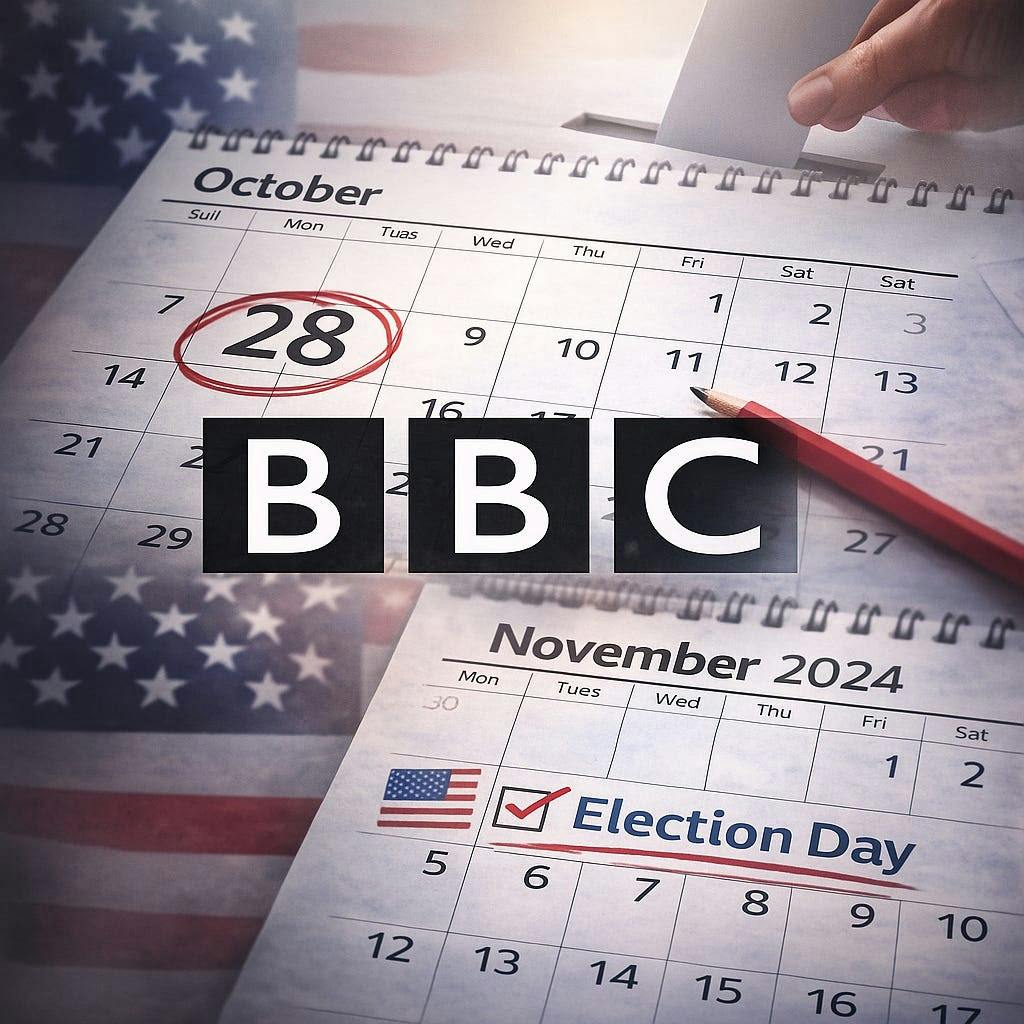
The BBC’s Panorama documentary “Trump: A Second Chance?” aired on October 28, 2024. Seven days before the election. Not seven weeks, not seven months—seven days.
In the world of election integrity analysis, timing like this isn’t background noise. It’s a flashing red signal.
This documentary landed during active early voting, during the final window when overseas and absentee ballots were being returned, at the precise moment when narrative shifts can no longer be corrected or countered. The complaint itself alleges this timing was intentional.
Consider what we know about information warfare: the closer to Election Day, the more decisive the impact, because there’s no time for rebuttal or course correction. This is Information Operations 101.
This wasn’t some local broadcaster accidentally reaching American audiences. The BBC is a global media empire—publicly funded (even by US taxpayers), operating under royal charter, with formal U.S. distribution partnerships reaching hundreds of millions worldwide.
They have an office in Coral Gables. They offer Florida-specific content pages. They distributed this documentary through BritBox and international partners, knowing full well that American voters would see it. The lawsuit documents this in exhaustive detail because foreseeability is what matters legally, not proving individual vote changes.
But here’s the part that should make your antenna go up: the complete silence around overseas voters.
Millions of Americans live abroad. They vote absentee. They consume international media at far higher rates than domestic voters. And unlike U.S.-based viewers, they face no technical barriers to BBC content.
Translation: overseas American voters were more likely to encounter this documentary, not less likely.
Yet somehow, in all the coverage of this lawsuit, no major outlet has asked the most obvious question: How many legally enfranchised American voters living overseas saw this content while voting?
That’s not an oversight. That’s a structural avoidance.
Your complaint documents BBC’s Florida reach but completely overlooks the most exposed population: 2.8-3.0 million Americans overseas eligible to vote under UOCAVA. Unlike domestic viewers facing geo-blocking, overseas voters—including military and civilian expatriates—had direct access to BBC content and consume international media at dramatically higher rates. With 600,000-1,000,000 overseas ballots typically requested per cycle (larger than most presidential margins), and the October 28 air date coinciding directly with active overseas voting windows, this population represents the strongest factual predicate for proving both foreseeability and electoral impact. Yet your complaint contains zero analysis of overseas voter exposure—the very evidence that could transform this from a defamation case into a documented election interference case.
Regular readers here know this story didn’t emerge in a vacuum. It lands amid everything we’ve already documented about UK-based actors intersecting with U.S. political processes under various banners of “safety” and “democracy protection.”
The leaked files revealing transnational influence operations. The documented election interference complaints involving UK political actors. The black ops memos targeting American political figures including RFK Jr. The coordinated pressure campaigns operating under the guise of content moderation.
Different theaters. Same operational DNA.
Calling it defamation is safe territory. Everyone understands media lawsuits. Pundits can debate editorial standards and legal precedents without breaking a sweat.
Calling it foreign election interference opens uncomfortable doors:
Should foreign state broadcasters face restrictions during American elections? Where’s the line between editorial bias and electoral manipulation? Why do we condemn some forms of foreign interference while normalizing others?
These questions cut too close to the institutional arrangements that govern how information moves across borders. Much easier to keep the conversation confined to familiar territory.
Strip away the personalities and partisan reflexes, and you’re left with a clean question: Can foreign entities knowingly inject false political narratives into the American electorate during decisive election windows—without accountability?
The answer to that question determines whether “election integrity” is a principle worth defending or just another political slogan.
The BBC case forces that question into the light. Which is probably why so many people seem determined to keep it in the dark.
Documents have a way of telling stories their authors never intended to tell. The BBC complaint, the internal whistleblower memo, the growing archive of cross-border influence operations—when you read them together, a picture emerges that’s hard to unsee.
The question isn’t whether our democratic processes are under threat. The question is whether they’re being quietly managed, and by whom.
And once you see that distinction, and the players involved, it’s impossible to look at these cases the same way again.