

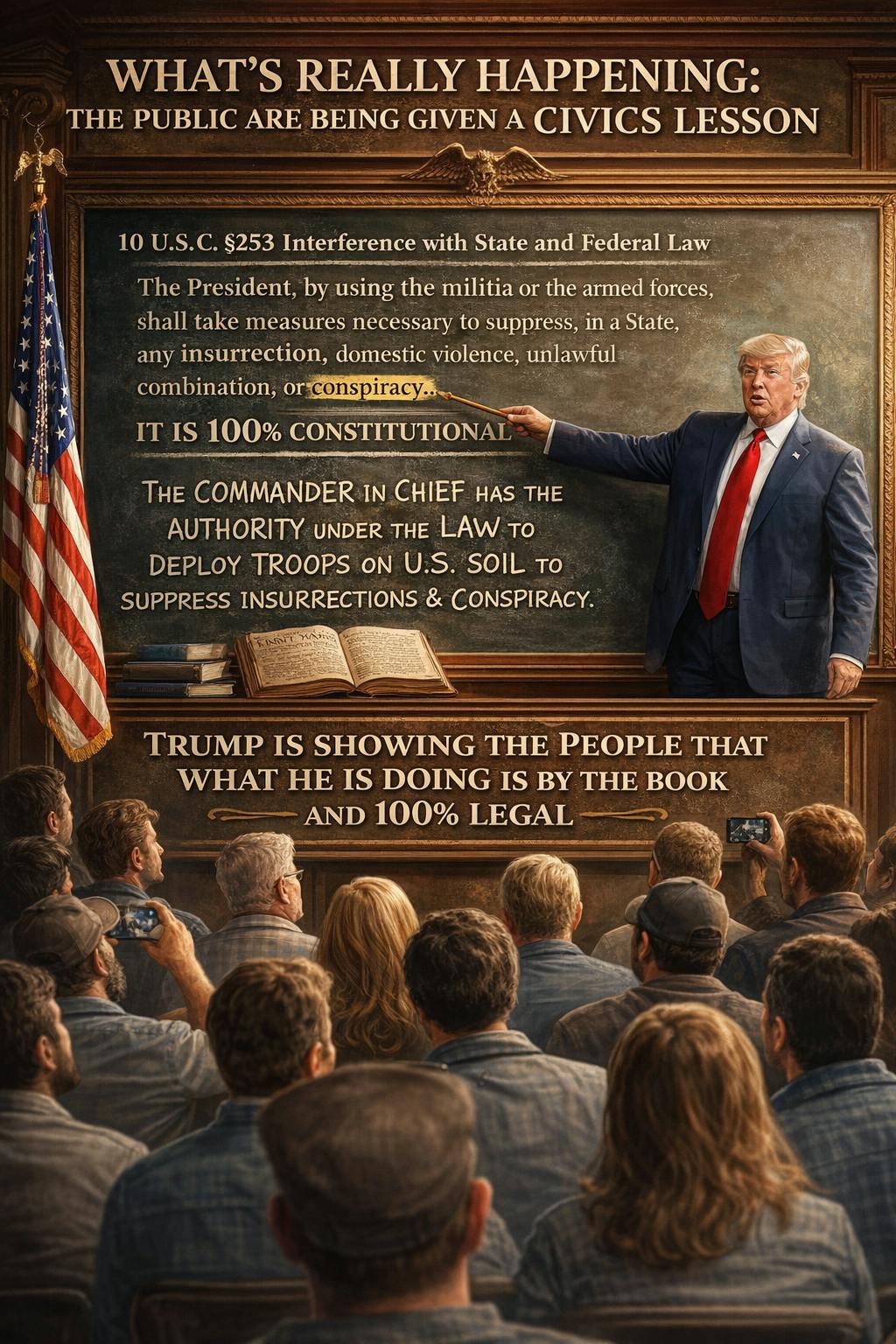
What is really happening beneath the noise of headlines and partisan outrage is that the American public is being given a long-overdue civics lesson. This lesson is grounded not in rhetoric or fear, but in the actual text, structure, and historical application of the U.S. Constitution. President Donald J. Trump has repeatedly and deliberately explained the lawful authority of the Commander in Chief to deploy military forces on U.S. soil under clearly defined circumstances. These circumstances include the suppression of insurrections, the enforcement of federal law when states are unwilling or unable to act, and the disruption of unlawful combinations or conspiracies that threaten constitutional order.
These powers are not novel inventions, authoritarian impulses, or legal loopholes. They are explicitly rooted in Article II of the Constitution and codified through long-standing federal statutes such as the Insurrection Act. This authority has been exercised by multiple presidents throughout American history, including Thomas Jefferson, Abraham Lincoln, and Dwight Eisenhower. In each case, it was used during moments of national crisis when civil authorities failed to protect citizens’ rights or preserve the rule of law.
By discussing these authorities openly and in advance, Trump is not conditioning the public to accept tyranny. Instead, he is preparing citizens to recognize lawful constitutional action when it occurs. This prevents the public from being emotionally manipulated into panic by predictable narratives from partisan political actors and legacy media outlets. Those narratives will almost certainly accuse any decisive federal action of being “dictatorship” or a “violation of the Constitution,” regardless of its legality.
This preemptive transparency serves a strategic civic purpose. It educates citizens on the difference between lawful constitutional enforcement and genuine abuses of power. It also reinforces the principle that the Constitution itself anticipates disorder and provides remedies to protect the Republic when normal processes break down. Far from operating in secrecy or outside the law, Trump’s approach emphasizes that any such actions would be taken by the book, within statutory authority, and subject to legal constraints.
Ultimately, this reminder matters because the Constitution is not a suicide pact. Federal authority exists to defend the nation against both foreign and domestic threats. Understanding these constitutional mechanisms is essential to resisting misinformation, maintaining public calm, and ensuring that lawful governance is not mistaken for tyranny simply because it is forceful, decisive, and constitutionally grounded.