
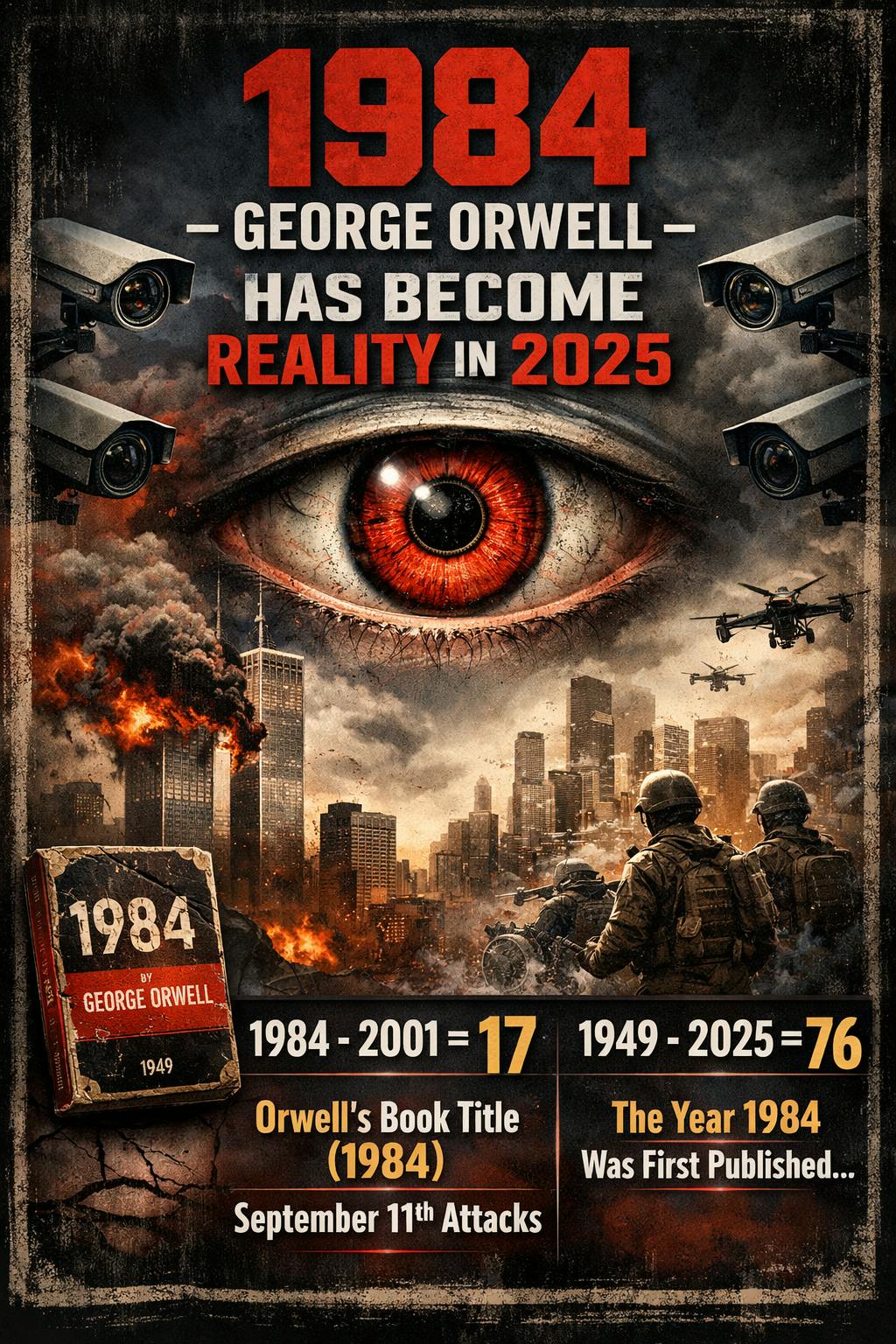
It may seem rhetorical to ask whether the narrative of Nineteen Eighty-Four has escaped the confines of literature and settled into lived reality, yet in 2025 that question no longer feels speculative but observational, as the core mechanisms Orwell warned against—mass surveillance, narrative control, psychological compliance, and the manipulation of truth—have become normalized features of modern life rather than distant dystopian fantasies. Written in 1949 and published as a warning to future generations, 1984 described a society where power is maintained not primarily through visible force but through constant monitoring, language distortion, manufactured consensus, and the erosion of independent thought, all of which now exist in forms Orwell could scarcely have imagined but clearly anticipated in principle. The digital age has transformed telescreens into smartphones, microphones into virtual assistants, and data collection into an invisible infrastructure that tracks movement, speech, preferences, and beliefs under the banner of convenience and security. Governments and corporations alike now possess unprecedented insight into individual behavior, while citizens are conditioned to accept this surveillance as normal, even beneficial, illustrating Orwell’s central insight that the most effective form of control is the one willingly embraced. Language itself has been hollowed and reshaped through political messaging, algorithmic censorship, and ideological framing, echoing Newspeak’s purpose of shrinking the range of acceptable thought by narrowing vocabulary and redefining words until dissent becomes linguistically difficult to express. The concept of objective truth—once a shared foundation for public life—has been destabilized by information overload, selective enforcement of “misinformation,” and the strategic amplification or suppression of narratives, making Orwell’s idea that “who controls the past controls the future” disturbingly relevant as history is revised, contextualized out of existence, or reframed to serve present power. Even the psychological dimension of 1984 finds resonance today, as fear, crisis, and perpetual emergency are used to justify extraordinary measures, conditioning populations to trade liberty for perceived safety while internalizing compliance as moral virtue. When examined symbolically, the numerical echoes deepen the sense of convergence: 1984 to 2001 spans seventeen years, linking Orwell’s title to a pivotal moment that reshaped global surveillance, security policy, and the justification for permanent monitoring, while the span from 1949 to 2025 marks seventy-six years—long enough for a warning to mature into a lived reality across generations; taken together, those two figures—seventeen and seventy-six—form 1776, the founding year of the United States, a powerful symbolic reminder that the very nation established on the principles of liberty, self-governance, and resistance to tyranny now finds itself grappling with the same forces of centralized power and psychological control that Orwell cautioned against, as if history itself is signaling a reckoning between the ideals born in 1776 and the managed reality unfolding in 2025. Orwell did not predict specific technologies or events; rather, he diagnosed a pattern of power that exploits fear, shapes perception, and governs minds before bodies, a pattern now visible in social credit systems, digital blacklists, behavioral nudging, and the quiet punishment of those who question approved narratives. In this sense, 1984 has not merely “come true” in a literal way but has unfolded structurally, as societies drift toward managed realities where comfort masks captivity, dissent is reframed as danger, and truth becomes negotiable. The most unsettling realization in 2025 is not that Orwell was right, but that his warnings are now so familiar they are often dismissed as exaggerated, even as their mechanisms operate openly, proving that the final victory of authoritarian control is not domination by force, but the normalization of its logic in everyday life.