

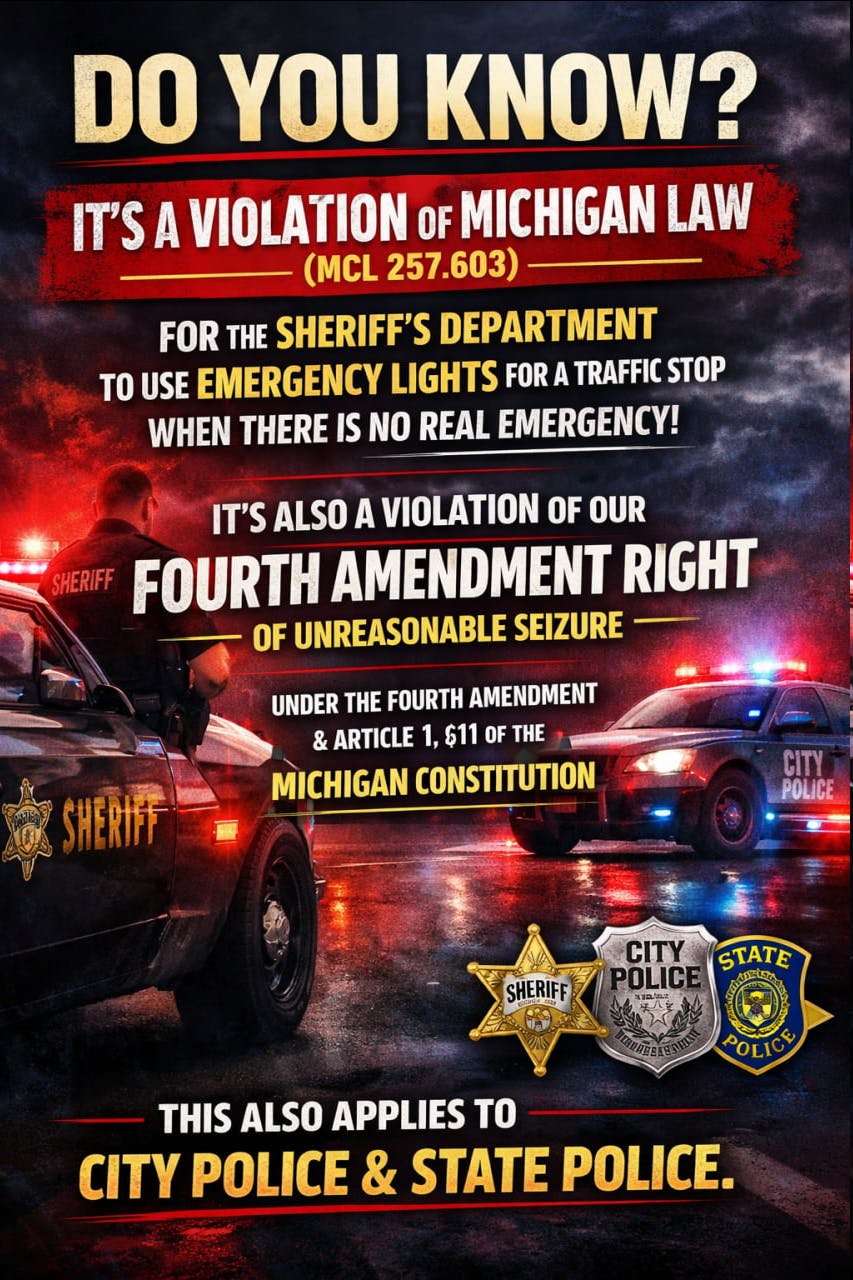
In Michigan, it is unlawful and plainly contrary to Michigan law—specifically MCL 257.603 and Article 1, §11 of the Michigan Constitution—for law enforcement officers to use emergency lights and sirens to initiate traffic stops. Under MCL 257.603, emergency lights and sirens may be lawfully activated only when an officer is responding to an actual emergency call, actively pursuing an actual or suspected law violator, or performing another legitimate emergency function, and even then only when the use of such equipment is reasonably necessary under the circumstances. Routine traffic stops do not constitute emergencies under the law.
This means that law enforcement officers may not lawfully stop an individual absent probable cause that a crime has been committed, or at minimum, a reasonable and articulable suspicion that the individual is engaged in criminal activity involving harm or injury to another person, damage to property, or stolen property. Outside of these narrowly defined circumstances, police officers—including sheriff’s deputies, city police, and state police—lack lawful authority to stop, detain or seize an individual through the use of emergency signaling equipment.
Despite these clear statutory and constitutional limitations, law enforcement agencies continue to employ emergency lights and sirens in violation of MCL 257.603 and Article 1, §11 of the Michigan Constitution. This practice persists largely because far too many people are not adequately informed or educated about their rights or the lawful boundaries governing police authority. Constitutional protections do not erode through repetition or convenience, and unlawful practices do not become lawful simply because they are widespread or uncontested. An informed public is essential to preserving the rule of law and preventing the normalization of unconstitutional conduct.