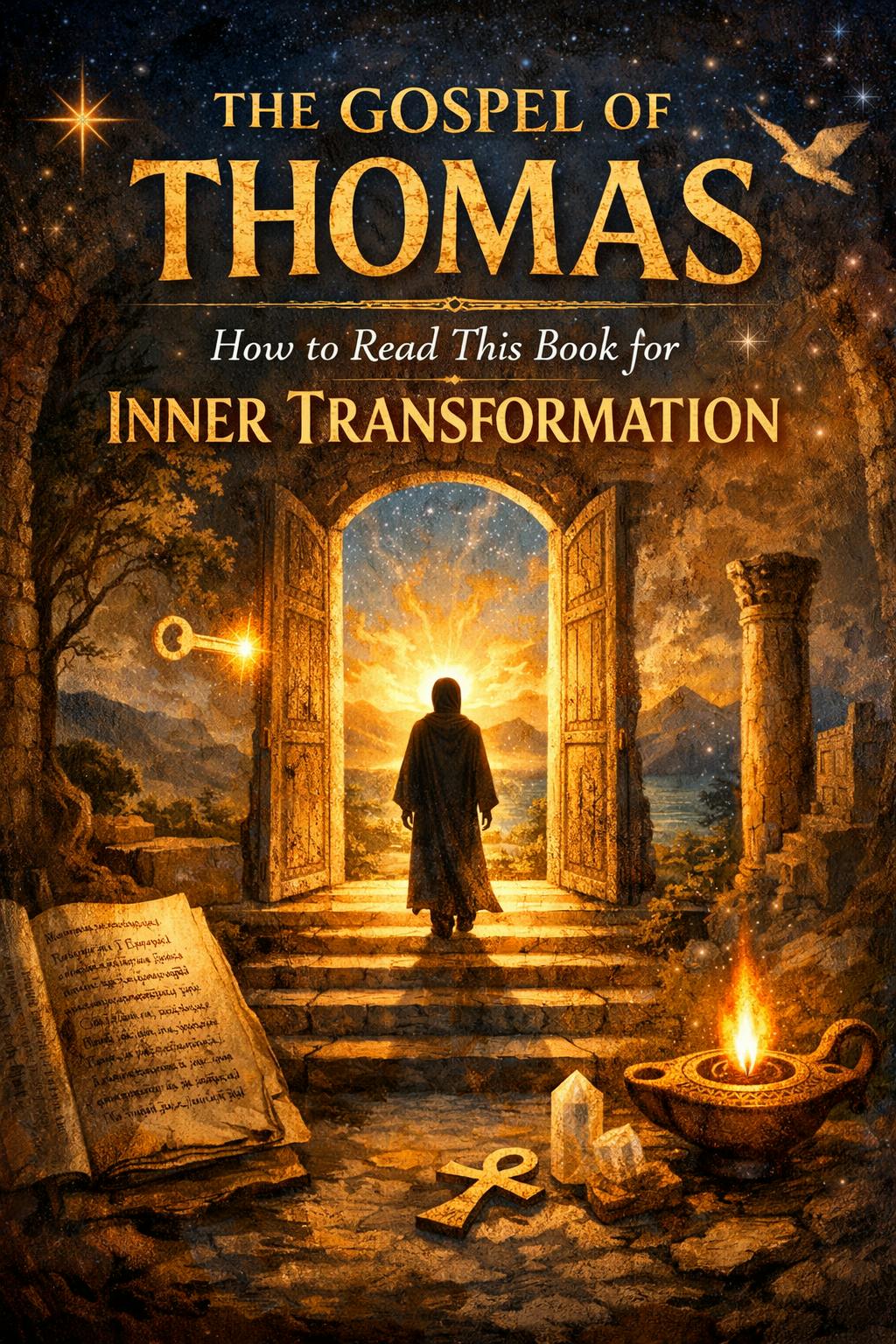

To read The Gospel of Thomas for inner transformation, one must first release the mindset, perspective, and habits formed by the biblical canon authorized by the early institutional Roman church—structures that continue to be upheld and promoted within many modern institutional churches today. This is not a text meant to be consumed for information, moral reinforcement, or theological agreement. It does not ask the reader to accept doctrines, memorize creeds, or align with an institution. Instead, it invites a slower, more deliberate encounter—one rooted in attentiveness rather than certainty. Each saying functions less like a rule and more like a mirror, reflecting the inner condition of the one who approaches it. Reading in this way requires patience and humility, because the text does not unfold its meaning all at once. What appears obscure or even contradictory on first reading often reveals layers of significance only after time, lived experience, and honest self-examination. The reader is not positioned as a passive recipient of truth, but as an active participant in its unveiling.
At the heart of this text is a radical reorientation of where truth, life, and the Kingdom itself are found. The Gospel of Thomas opens the door not to belief, but to inner awakening and direct knowing. Again and again, it points the reader inward, affirming that the divine spark—the source of life, light, and understanding—is already present within each individual. The Kingdom of Heaven is not portrayed as a distant realm to be earned through obedience, ritual, or institutional approval, nor as a future reward deferred until death. Instead, it is revealed as an immediate reality, readily accessible through awareness, self-knowledge, and inner alignment. In doing so, the text quietly but unmistakably exposes the framework of the institutional church, which has long redirected seekers toward external authority, external validation, and an externalized kingdom promised “someday.” Thomas dismantles this displacement by restoring spiritual agency to the individual, insisting that what has been sought outwardly has always been present inwardly, waiting not to be believed—but to be recognized.
This book should be approached as a dialogue rather than a declaration. You do not read a saying once and move on; you return to it repeatedly, allowing it to confront different stages of your inner life. Questions are not obstacles here—they are the doorway. When a saying unsettles you, confuses you, or resists easy interpretation, that resistance is the work itself. The Gospel of Thomas speaks directly to the part of the human being that exists beneath conditioning and indoctrination, beyond religious performance, and below the ego’s need to be right. It challenges the reader to observe their reactions honestly: Where do I resist? Where do I feel exposed? Where do I feel recognized? Transformation does not occur by agreement, but by recognition—by seeing something true about oneself that was previously hidden or ignored. In this way, reflection becomes more important than conclusion, and silence more instructive than commentary.
Ultimately, this is not a gospel that gives answers to be possessed, but an awakening to be lived. Its purpose is not to explain reality, but to reorient perception. As you read, you may find that the same saying speaks differently at different times, revealing that the text itself has not changed—you have. This is the measure of inner transformation. The Gospel of Thomas operates on the principle that truth is not imported from outside, but remembered from within. Its sayings are catalysts, not conclusions, designed to awaken awareness rather than enforce belief. When read in this way—slowly, honestly, and without the need to resolve every tension—the book becomes less a collection of words and more a process of becoming. It teaches not by telling you what to think, but by awakening your capacity to see, to remember, and to recognize truth.