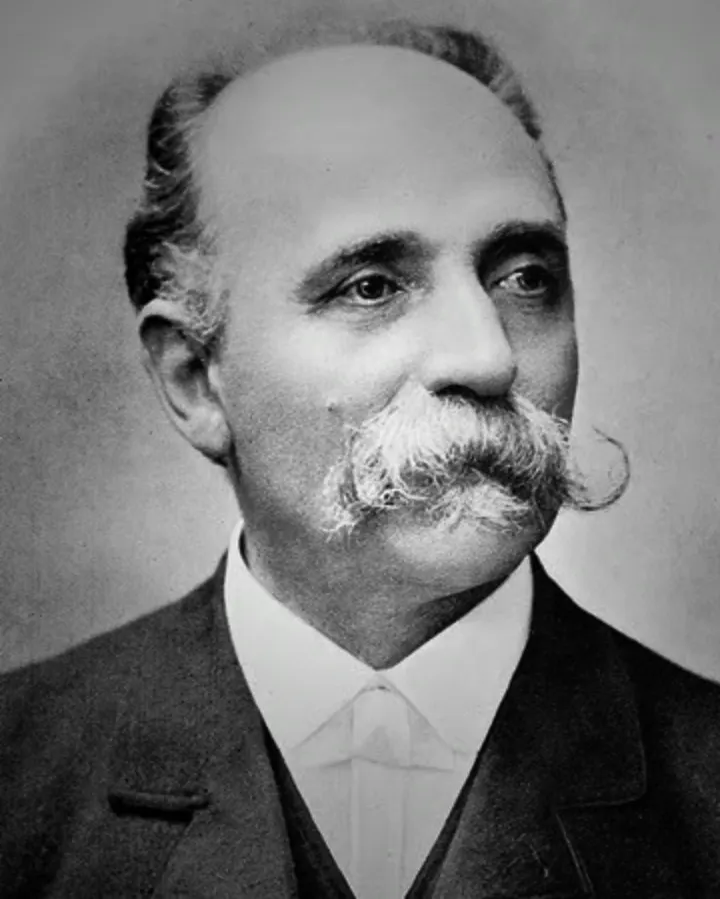

Camillo Golgi made groundbreaking contributions to neuroscience and cell biology. He developed a revolutionary staining technique that allowed for detailed observation of nerve cells, which transformed the field of neuroscience.
Golgi studied medicine at the University of Pavia under Cesare Lombroso. In 1873, he created the "black reaction" method, a staining technique that made it possible to view individual neurons in brain tissue. This discovery opened new avenues for studying the nervous system's structure.
In 1898, Golgi identified a cellular structure that would later be named the Golgi apparatus. This organelle plays a crucial role in processing and packaging proteins within cells. Golgi also made significant contributions to malaria research, helping to establish different types of the disease and confirming its transmission by mosquitoes.
Golgi shared the 1906 Nobel Prize in Physiology or Medicine with Santiago Ramón y Cajal for their work on the nervous system. Despite this shared honor, the two scientists held conflicting views on the structure of the nervous system. Golgi supported the reticular theory, while Ramón y Cajal championed the neuron doctrine.
Throughout his career, Golgi held important positions at the University of Pavia, serving twice as its rector. During World War I, he directed a military hospital, applying his medical expertise to aid wounded soldiers. Golgi married Lina Aletti, the niece of his mentor Giulio Bizzozero, but the couple had no children.
In his later years, Golgi became an agnostic atheist. In the years after his death in 1926, the town of his birth, Corteno, was renamed Corteno Golgi in his honor.
Born: July 7, 1843
Birthplace: Corteno, Kingdom of Lombardy–Venetia, Austrian Empire
Died: January 21, 1926 (aged 82)
From this link: https://www.onthisday.com/people/camillo-golgi