
Operation Paperclip was a secret United States intelligence program in which more than 1,600 German scientists, engineers, and technicians were taken from former Nazi Germany to the U.S. for government employment after the end of World War II in Europe, between 1945 and 1959. Conducted by the Joint Intelligence Objectives Agency, also known as (JIOA), it was largely carried out by special agents of the U.S. Army's Counterintelligence Corps, also known as (CIC). Many of these personnel were former members, and some were former leaders, of the Nazi Party.
Operation Paperclip had indirect connections to research related to mind control and other psychological experiments, although its primary focus was on recruiting German scientists and engineers for technological and scientific advancements rather than specifically for mind control research.
After World War II, the United States government sought to bring German scientists and experts, including those involved in various scientific and medical fields, to the United States under Operation Paperclip. Among the scientists brought to the U.S. were individuals who had conducted research related to psychology, psychiatry, and the effects of drugs on the human mind. Some of these scientists had been involved in wartime experiments, including those related to mind-altering substances and interrogation techniques.
One notable figure associated with Operation Paperclip is Dr. Walter Schreiber, a German medical officer who conducted research on various topics, including the effects of drugs and toxins on the human body. While in the United States, Dr. Schreiber provided information on his wartime research, including experiments involving mescaline and other psychoactive substances. This information contributed to the early exploration of mind-altering drugs and their potential applications, although it was not the primary focus of Operation Paperclip.
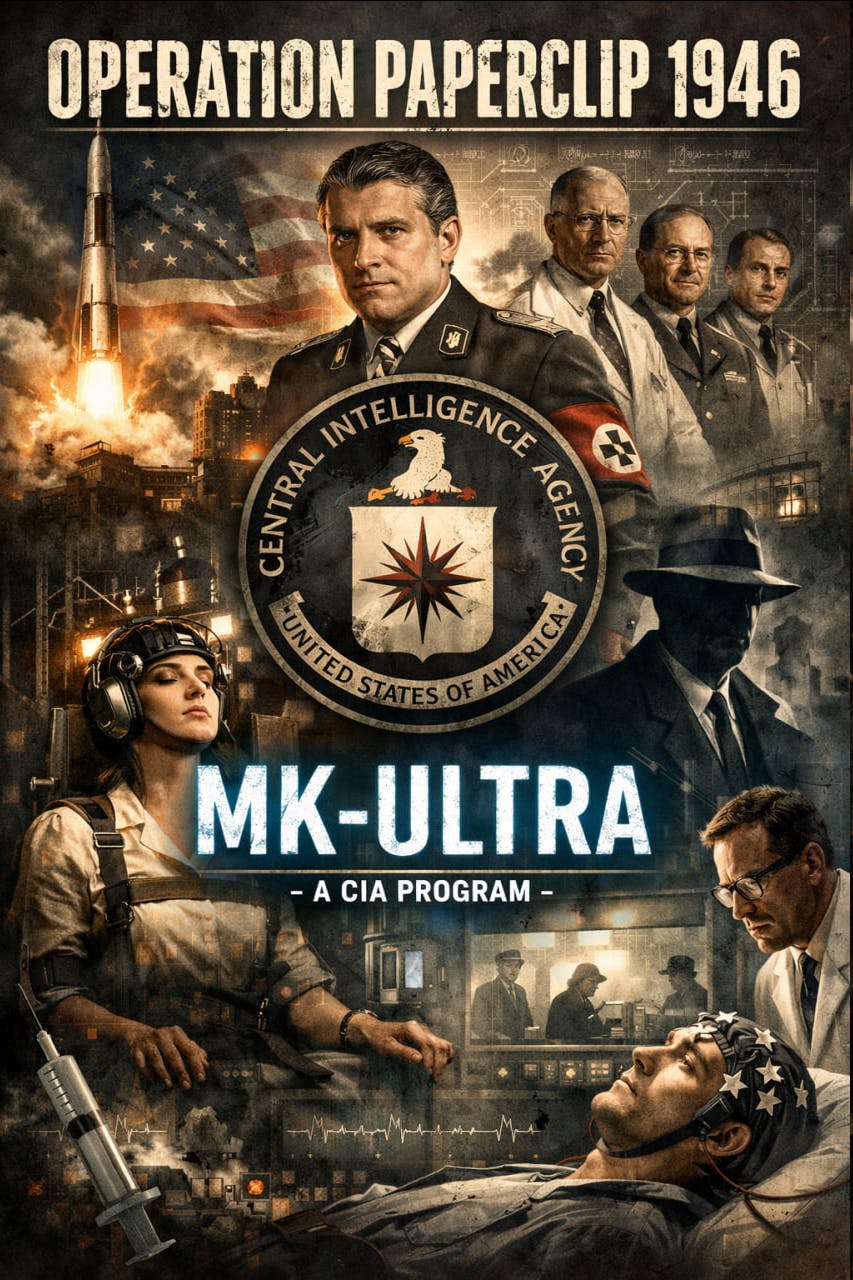
It's important to note that the U.S. government's interest in mind control and related research expanded in the post-war period, leading to projects like MK-Ultra, which were conducted independently of Operation Paperclip. MK-Ultra, a CIA program, aimed to explore the use of mind-altering substances and techniques for various purposes, including interrogation and behavior modification.