
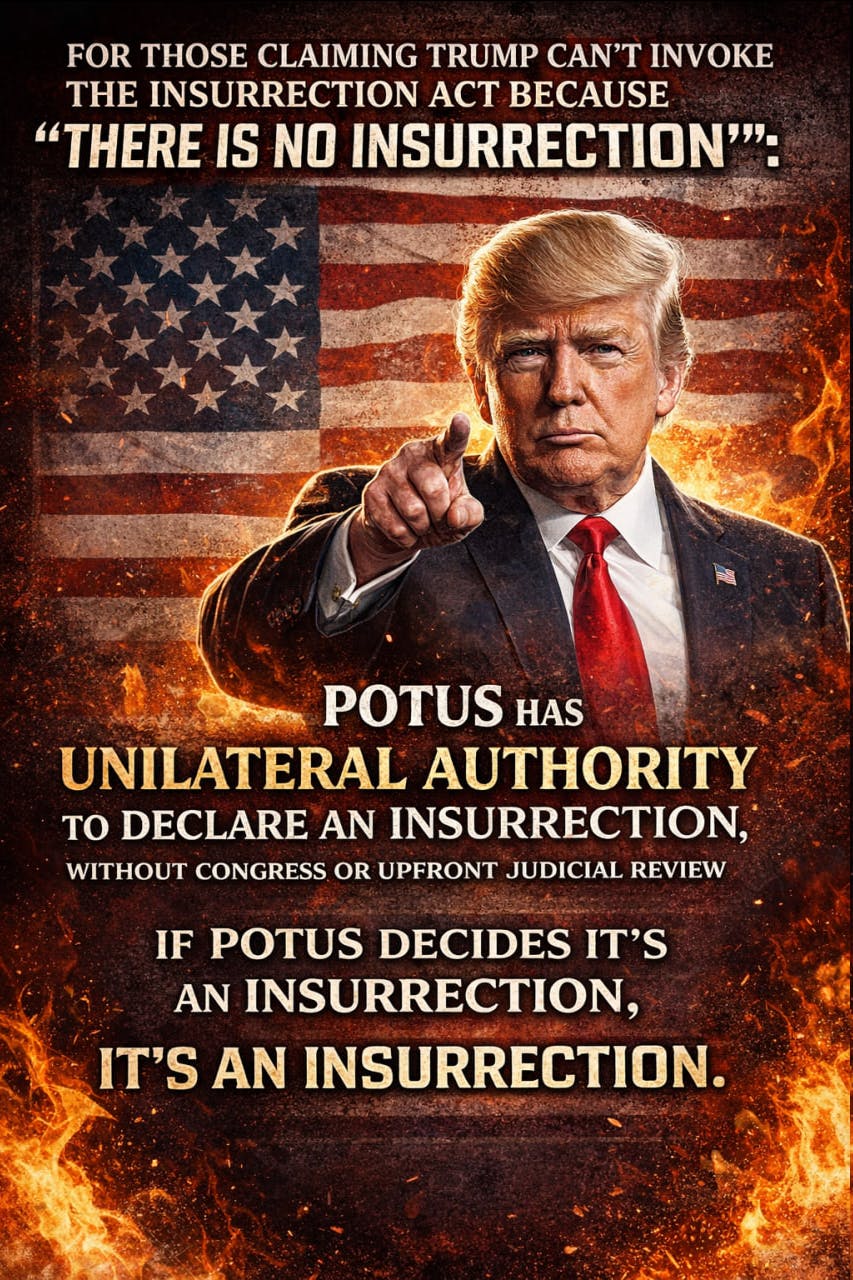
Much of the public debate surrounding the Insurrection Act is driven less by constitutional reality and more by political rhetoric. A common claim is that a president cannot invoke the Act unless an “insurrection” is first formally acknowledged or validated by Congress or the courts. In fact, the opposite is true under both constitutional structure and longstanding historical practice. The authority to determine whether conditions rise to the level of an insurrection is vested squarely in the President of the United States as Commander in Chief under Article II of the Constitution.
The Insurrection Act itself does not require congressional approval, a prior declaration, or upfront judicial review. It does not delegate that determination to governors, state legislatures, or media consensus. Instead, it empowers the president to act decisively when he determines that unlawful obstructions, domestic violence, or combinations of force are preventing the execution of federal law or depriving citizens of constitutional rights that state authorities are unwilling or unable to protect. This means the determination is inherently executive in nature and necessarily discretionary to allow for rapid response to emergencies.
This interpretation is neither novel nor controversial. Presidents from Thomas Jefferson and Abraham Lincoln to Dwight Eisenhower and John F. Kennedy exercised this authority based on their own judgment of conditions on the ground, often in the face of intense political opposition. Courts have historically been reluctant to second-guess such determinations in advance because they fall within the political question doctrine and the president’s core national security and law-execution powers.
When critics argue that “there is no insurrection,” they often confuse political disagreement or media framing with lawful standards. The law does not require a formal uprising, civil war, or universally agreed-upon label. It requires only that the president conclude the conditions exist. Once that determination is made, it carries legal force by operation of law.
Thus, if President Donald J. Trump or any sitting president determines that the threshold has been met, that decision itself constitutes the operative declaration. Any judicial review that occurs would take place after the fact, not as a prerequisite. This reflects a core constitutional principle: the executive branch is designed to act swiftly to preserve order and enforce the law when other mechanisms fail, not to wait for permission while conditions deteriorate.