

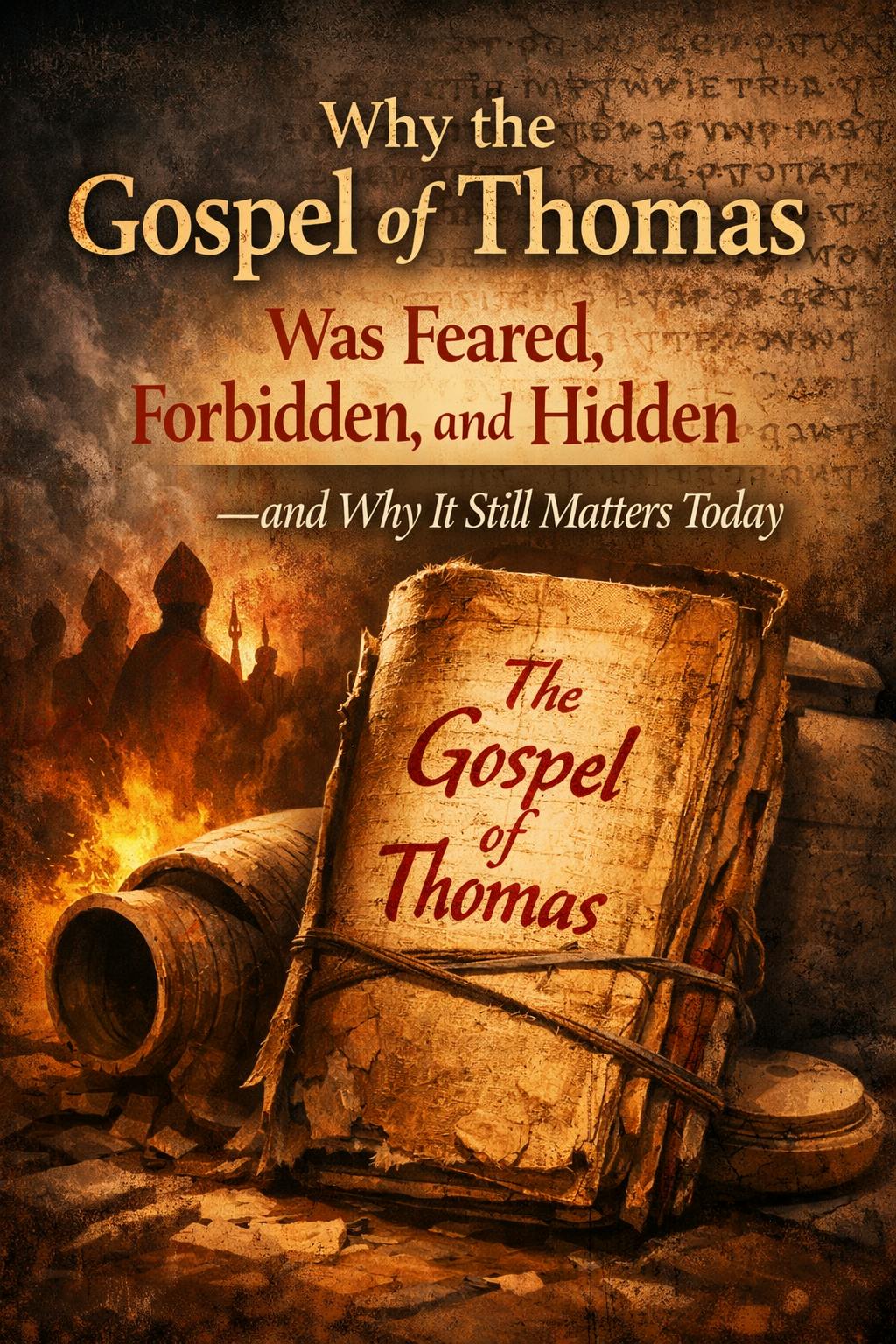
For centuries, the Gospel of Thomas existed in obscurity, excluded from the official biblical canon and largely unknown to the wider public until its rediscovery in 1945 among the Nag Hammadi Library. The reasons for its suppression are deeply tied to power, authority, and control over spiritual interpretation. Unlike the canonical gospels, which emphasize belief in doctrines mediated by institutional authority, the Gospel of Thomas presents 114 sayings attributed to Yeshua that focus on direct knowledge, inner awakening, and individual transformation. Its opening declaration—“Whoever finds the interpretation of these sayings will not experience death”—sets the tone for a text that places salvation not in obedience to hierarchy or ritual, but in understanding and lived realization. Such a message posed a direct challenge to an emerging church structure that sought unity through creed, uniform teaching, and centralized authority. A gospel that taught individuals to seek truth within themselves threatened to dissolve the monopoly on spiritual mediation that institutions were actively constructing.
The early Roman Church, which later evolved into what we now recognize as the Roman Catholic Church, was not merely safeguarding doctrine; it was building an empire of belief. In the centuries following Yeshua’s life, church leaders faced intense pressures—political, cultural, and theological—to define orthodoxy and eliminate competing interpretations. Texts like the Gospel of Thomas, labeled “gnostic” (from gnosis, meaning knowledge), were dangerous precisely because they emphasized inner knowing over external authority. If the Kingdom of Heaven was already within each individual, as Thomas repeatedly asserts, then priests, sacraments, and ecclesiastical control were no longer the exclusive gateways to the Creator. This internalized spirituality undermined the institutional claim to be the sole arbiter of salvation. Suppressing such texts was therefore not an accident of history, but a strategic decision to preserve cohesion, obedience, and control in a rapidly expanding religious-political system.
What makes the continued suppression—or dismissal—of the Gospel of Thomas by many modern institutional churches especially significant is that the same underlying fear persists: the loss of control over spiritual interpretation. Even today, the dominant religious model prioritizes belief over knowing, conformity over inquiry, and external authority over inner conscience. The Gospel of Thomas does not ask the reader to accept dogma blindly; it demands engagement, self-examination, and responsibility. Its teachings insist that truth cannot be handed down fully formed by institutions—it must be discovered, interpreted, and embodied by the individual. This is profoundly unsettling to systems built on hierarchical power, because it places spiritual authority back into the hands of the seeker. The text strips away spiritual intermediaries and confronts readers with a radical proposition: that enlightenment is not granted by the Church, but realized through awareness.
For those who read the Gospel of Thomas from beginning to end, the impact is unmistakable. What emerges is not a rejection of Yeshua, but a deeper encounter with his teachings—one that reframes salvation as awakening rather than rescue, and the Kingdom as a present reality rather than a distant reward. The “Divine spark” described in this gospel is not reserved for saints or clergy; it exists within every individual, waiting to be recognized and lived. This recognition is not automatic—it requires conscious choice, honesty, and courage—but once embraced, it strips belief of its false authority and calls the reader into lived knowing. That is precisely why this gospel has been feared, forbidden, hidden, and marginalized: it empowers individuals to encounter truth directly. And that is also why, in our time, its rediscovery matters more than ever.