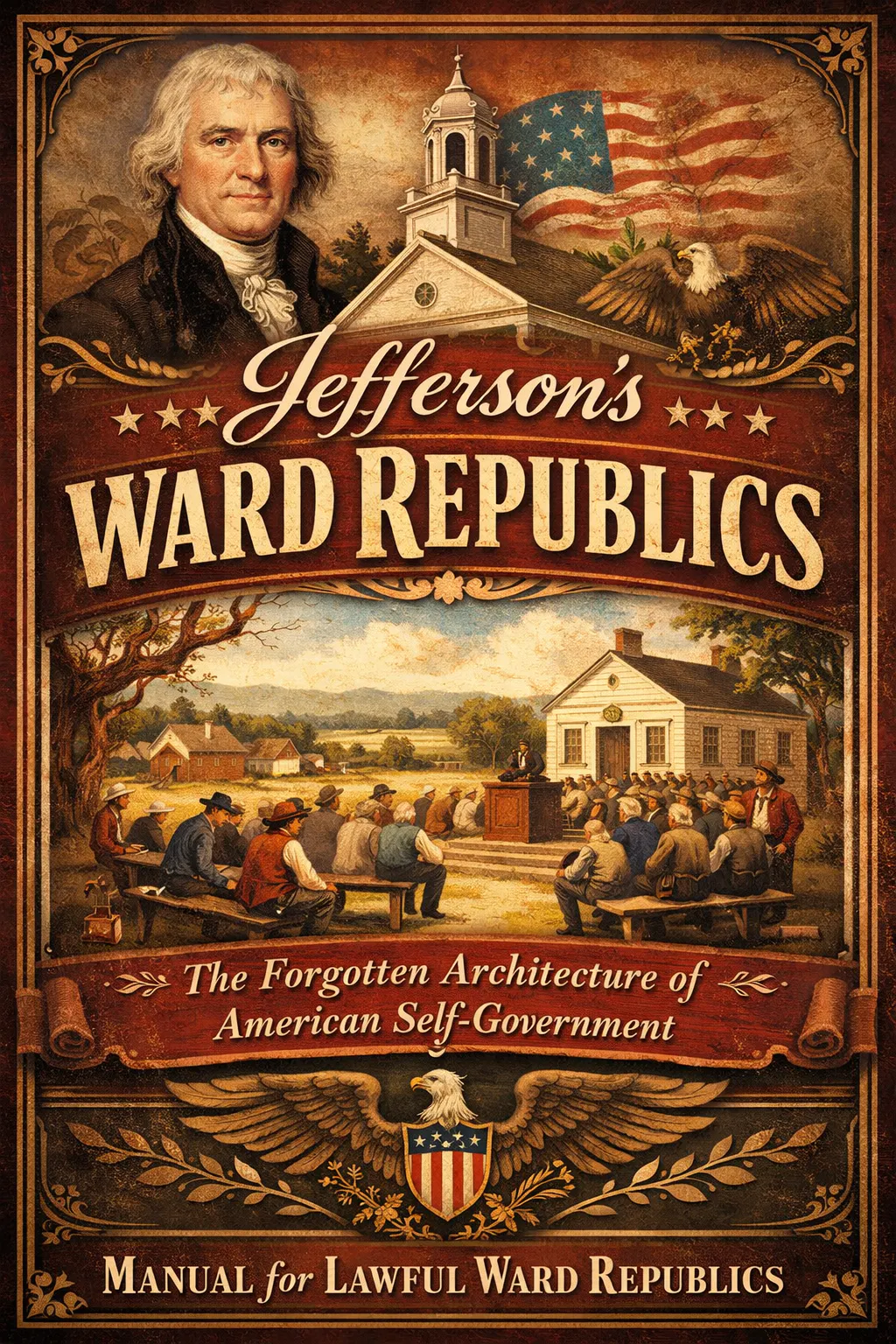


The purpose of this manual is to restore understanding of one of the most important, yet most neglected, principles of American self-government: the ward republic, as conceived and articulated by Thomas Jefferson. This manual exists to document, explain, and preserve Jefferson’s vision of decentralized civic authority, in which the People do not merely select rulers at a distance, but actively govern themselves at the most local and personal level of society.
Jefferson believed that liberty could not survive where power was concentrated far from the people it governed. He warned repeatedly that large, remote systems of authority—even when cloaked in republican forms—inevitably drift toward corruption, apathy, and elite control. His answer was not more regulation or better administration, but a structural solution: the division of political power into small, manageable civic units called wards, each functioning as an “elementary republic.” In these wards, citizens would know one another, deliberate together, serve on juries, maintain roads and schools, organize local defense, and hold public officials directly accountable.
This manual is not written as a historical curiosity, a philosophical essay, or a partisan argument. It is intended as a practical civic reference that bridges theory and application. Its purpose is to clarify what ward republics are, how they function, why they were central to Jefferson’s conception of republican government, and how their absence has reshaped modern governance in ways that undermine popular sovereignty. By presenting ward republics as a coherent system—rather than as scattered quotations or abstract ideals—this manual seeks to correct widespread misunderstandings about the nature of self-government in the American tradition.
A central purpose of this manual is to distinguish governing from voting. Modern political culture often treats participation in periodic elections as the sum total of civic duty. Jefferson rejected this notion entirely. He understood that liberty requires continuous involvement, shared responsibility, and localized decision-making. When citizens are removed from daily governance, power does not disappear—it relocates upward, into administrative structures that are insulated from public oversight. This manual explains how ward republics were designed specifically to prevent that transfer of authority.
This manual also serves an educational purpose. Generations of Americans have been taught a simplified version of constitutional government that emphasizes institutions while neglecting the foundational role of the people themselves. Concepts such as common-law juries, local courts of record, citizen oversight of officials, and neighborhood-level governance have been largely omitted from modern civic instruction. By restoring these concepts to their proper place, this manual aims to equip readers with the historical and intellectual tools necessary to understand how republican government was intended to function at its base.
Another core purpose of this manual is to provide a conceptual framework for civic restoration. While it does not prescribe specific statutes, charters, or political programs, it establishes the structural logic necessary for any lawful return to genuine self-rule. Readers will find in these pages the principles that underlie bottom-up authority, local jurisdiction, and the moral responsibility of citizens to govern themselves. This framework is applicable across regions, communities, and eras because it is rooted in human scale, accountability, and participation rather than in transient policy debates.
Finally, this manual exists to remind readers that self-government is not a convenience—it is a discipline. Ward republics require informed citizens, active participation, and a willingness to assume responsibility for the common good. Jefferson understood that freedom cannot be outsourced to distant institutions without being diminished. The purpose of this manual is to reawaken that understanding and to preserve the knowledge that the republic does not begin in capitals, courts, or agencies—it begins at home, among neighbors, in the smallest units of shared civic life.